
Dental Health Blog
Dental Filling vs. Crown: How Dentists Decide Which One You Need
Not sure why a cavity needs a filling but another tooth needs a crown? Here's how dentists decide between the two, and what each one actually does.
Key takeaways
- Fillings work when enough healthy tooth structure remains to reliably support them.
- Crowns come into play when decay, cracks, or prior root canal treatment leave too little structure for a filling to hold.
- The decision depends on an X-ray and hands-on exam — not something you can judge yourself.
- Both options exist for the same reason: stopping damage from getting worse, not just patching a symptom.
- Regular checkups increase the odds a problem gets caught early enough to be a filling instead of a crown.
If you’ve ever had a dentist recommend a filling for one cavity and a crown for another, it can seem like an inconsistent call. It isn’t — the decision comes down to how much healthy tooth structure is left to work with.
What a filling is for
A filling repairs a tooth where the damage — usually decay, or a worn-out older filling — is limited enough that most of the natural tooth structure is still intact. The dentist removes the decayed portion and fills the resulting space with a material designed to bond to the remaining tooth and hold up under normal biting and chewing. Because most of the tooth is still there to work with, a filling can usually be completed in a single visit.
What a crown is for
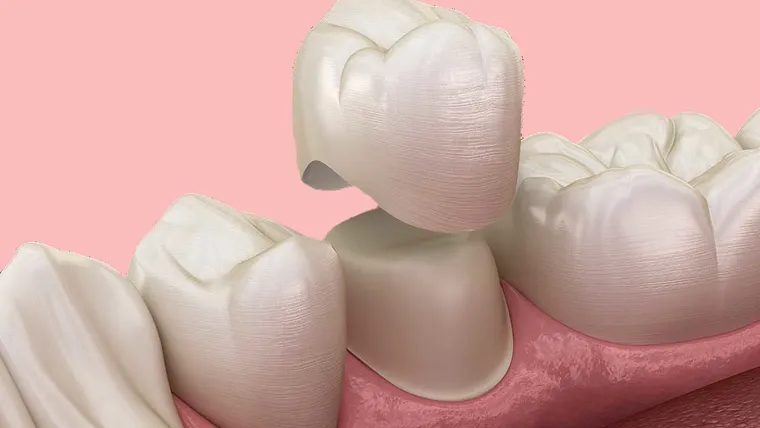
A crown comes into play when there isn’t enough healthy tooth left for a filling to reliably support — for example, if the decay is extensive, if a large old filling has failed, if the tooth has cracked, or if it’s had root canal treatment and needs additional protection against fracturing. Rather than filling a small space, a crown covers the entire visible portion of the tooth above the gumline, effectively rebuilding it and protecting what’s left of the natural structure underneath. Crowns and bridges can also be used to whiten, reshape, or realign a tooth, or to replace one that’s missing entirely.
So how does a dentist actually decide?
In practice, it comes down to a few questions your dentist is asking during the exam:
- How much healthy tooth structure remains? This is the main factor. A filling only works if there’s enough remaining tooth to support it.
- Is the damage limited to one surface, or has it spread? Decay confined to a small area is more likely to be filling territory; damage that’s compromised multiple surfaces of the tooth often points toward a crown.
- Has the tooth already had a root canal? Teeth that have undergone root canal treatment are more prone to fracturing afterward, since they lose some structural integrity, which is why crowns are often recommended as a follow-up.
- Is there a crack, not just decay? Cracks change the calculation, since a filling can’t hold a tooth together the way a crown can.
None of these are things you can reliably judge on your own — an X-ray and a hands-on exam are what actually determine which option makes sense for a specific tooth.
Both are meant to protect the tooth, not just patch it
It’s worth remembering that both a filling and a crown exist for the same underlying reason: catching damage and stopping it from getting worse, ideally before it turns into something more invasive like an extraction. Keeping up with regular checkups is what makes it more likely that a problem gets caught early enough to be a filling instead of a crown in the first place.
Have a tooth you’re wondering about?
If you’ve got a cavity, an old filling that doesn’t feel right, or a tooth that’s started giving you trouble, the only way to know which option applies is to have it looked at directly. Our Windsor team can take a look and walk you through what we’re seeing and why.
Common questions
Related FAQs
Does a crown hurt more than a filling?
Both procedures are done with local anesthetic, so the process itself shouldn't be painful. A crown does typically take more than one visit, since a lab-made crown needs to be fitted afterward.
Can a filling be replaced with a crown later if needed?
Yes. If a filled tooth develops more extensive decay or a crack down the line, a crown can be placed at that point to give it more support.
How long do fillings and crowns typically last?
Both can last many years with good oral hygiene, but neither is meant to be permanent. Regular checkups let your dentist catch wear or damage early, before it becomes a bigger issue.
Explore more
Related to this article
Have a question about your own smile?
Reach out and our team can walk you through what applies to your specific situation.